|
The decaflexagon has 10 triangles meeting in the center. Three variants are described here:
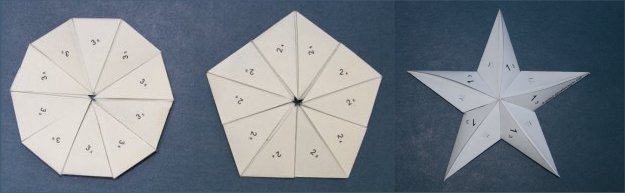
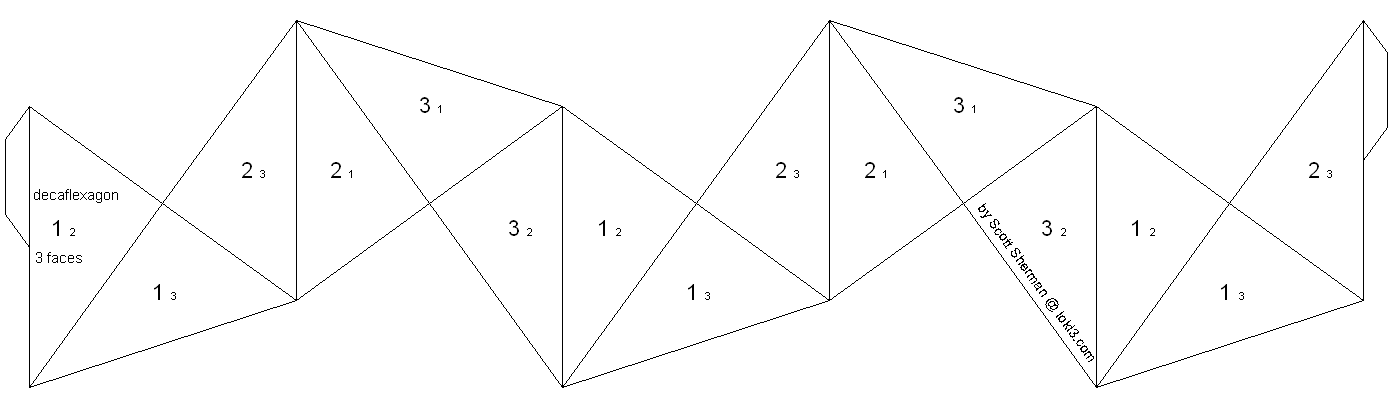
Isosceles and Right DecaflexagonThe decaflexagon has 10 triangles per face. Both versions allow you to do a pinch flex with 5-fold symmetry. The isosceles version allows you to do various pocket flexes when you fold it in half. The right triangle version allows you to fold out flaps and fold them back a different way. Cut out the net and pre-crease all the edges. Copy the small numbers on to the back. With the following isosceles net, fold 2 on 2. With the right triangle version, fold 3 on 3. Tape the tabs onto the appropriate faces.
Print out the following two strips and connect the 3/5 face to the 1/5 face. Fold 4 on 4, 5 on 5 and 6 on 6. Then fold 2 on 2 and tape the tabs to the appropriate faces.
Print out the following two strips and connect the 3/5 face to the 1/5 face. Fold 4 on 4, 5 on 5 and 6 on 6. Then fold 1 on 1 and tape the tabs to the appropriate faces
10-sided Isosceles DecaflexagonThe following is how to make the decaflexagon shown in the video above. Click on the two thumbnails below to get the larger versions. Each picture includes two copies of one side of the pieces you'll need. The full strip requires 5 copies of these pieces, so printing the pictures three times will give you an extra piece. You can either print the second picture on the back of the first or print them out separately and paste them back-to-back. One end of each piece should have 1 on one side and 2 on the other, while the other end has 3 on one side and 4 on the other. To connect the ends of each piece together, tape the short side of triangle 1 to the short side of triangle 4. Chain all 5 pieces together in this way to create the single strip shown in the video. 

Start by folding the first piece. Find the adjacent pair of 10's and fold them together. This should make a pair of 9's adjacent so you can fold them together. Continue by folding together 8's, 7's, 6's and 5's. Now fold together the adjacent 2's followed by the 3's. Repeat these same steps for each of the other four pieces of the overall strip. To finish it off, after folding together the last pair of 2's, you should find a 3 on each end of the strip. Place these together, then tape together the short end of the first and last leaves in the strip. You should now have a decagon with 1's on one side and 4's on the other. From here you can do the pinch flex, tuck flex, pyramid shuffle or others. As you experiment with various flexes on this flexagon, you will occassionally get stuck. The advantage of taping the pieces together is that you can remove the tape and refold it if you get too lost. Star Decaflexagon
Cut along the solid lines and pre-fold along the dashed lines. The dashed lines along the outside edge of triangles 2/3 and 4/2 indicate that these edges will be connected to another edge. Copy the small numbers onto the backs of the triangles. Tape the short side of triangle 1/3 in one of the four pieces to the short side of triangle 4/2 in a second piece such that 1 and 4 are on the same side and 2 and 3 are on the same side. Continue by connecting 1/3 in the second piece to 4/2 in the third, 1/3 in the third to 4/2 in the fourth, and 1/3 in the fourth to 4/2 in the fifth. Now fold adjacent pairs of 4's together and adjacent pairs of 3's together, creating a five pointed star. Finish by taping together the final 1/3 and 4/2. One flex that works on this star flexagon is the pivot flex. Next: The Dodecaflexagon |